Last Updated on 20 November 2026 at 11:56
An email may contain a complete account of a problem and still leave the director with most of the work of deciding what to do. The supplier’s explanations are there, the colleagues’ replies have been forwarded, and the final line reads: “Please advise.”
The person coordinating the matter usually knows which options remain available and which facts have been checked. The director, seeing the correspondence for the first time, must reconstruct those answers before deciding. A useful update puts the coordinator’s knowledge to work before asking for the executive’s judgement.
An executive update is decision-ready when it explains what changed, presents verified options, identifies the authority needed and makes the follow-through clear. The professional coordinating the matter does the checking and selects the relevant facts before asking for an answer. Sometimes the best result is an update that requires no decision at all.
Table of contents
Put the point of the message where the reader will see it
The opening should tell the executive what needs attention and why. If a revised delivery date threatens preparations for a client visit, say that. If an approval is needed before a supplier releases a reservation, give the cutoff. If the matter has already been resolved within the agreed authority, report the outcome and make clear that no response is required.
Background still has a place. A director may need to know why a preferred option was ruled out, whether a figure has been confirmed or which customer commitment is affected. Those details deserve space because they influence the answer. An email chronology, copied in full, rarely gives them the right prominence.
A reference to the working file or the latest supplier confirmation can preserve the evidence without making the reader navigate it. The director can see the reasoning immediately, while the source remains available if a detail is challenged or circumstances change.
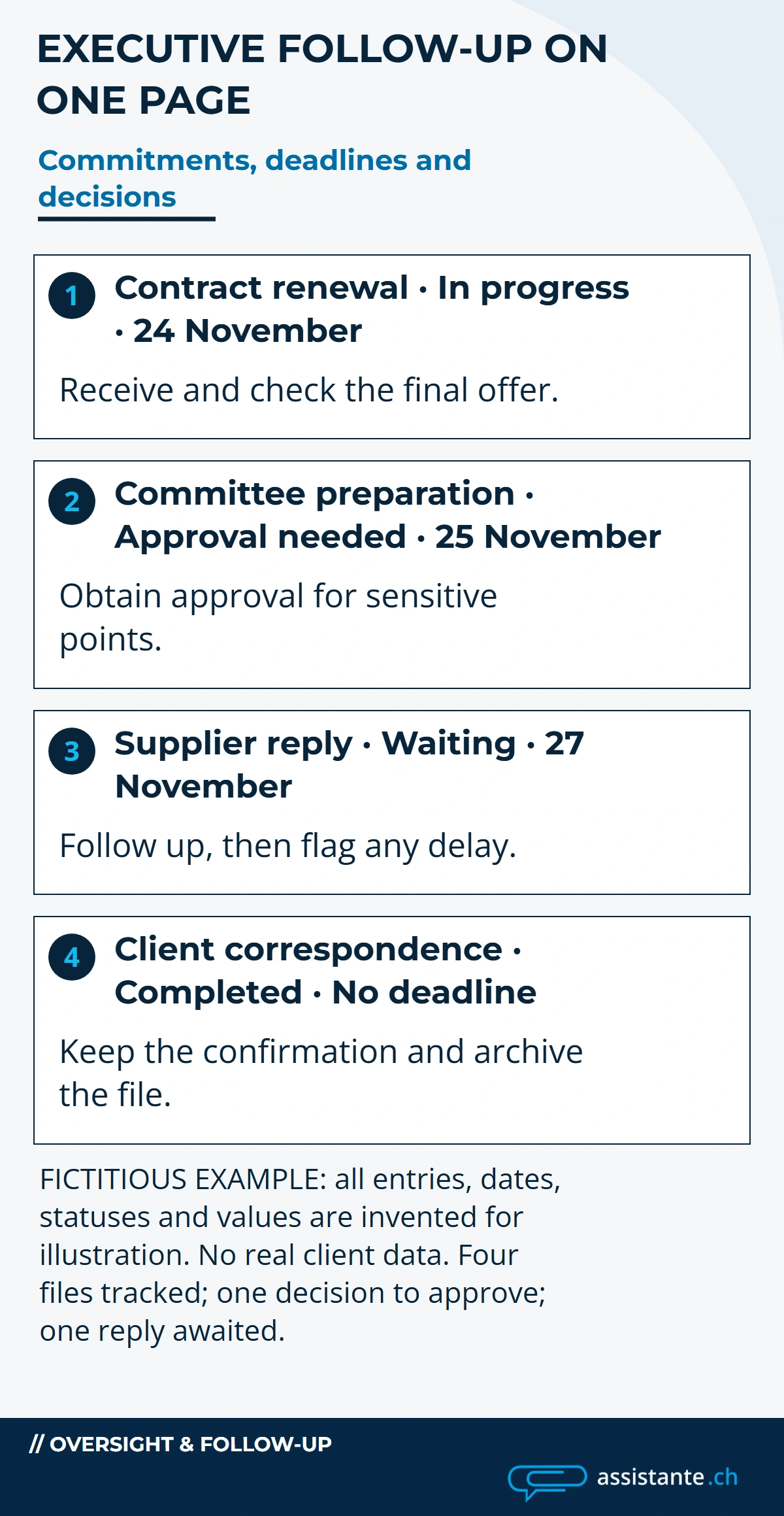
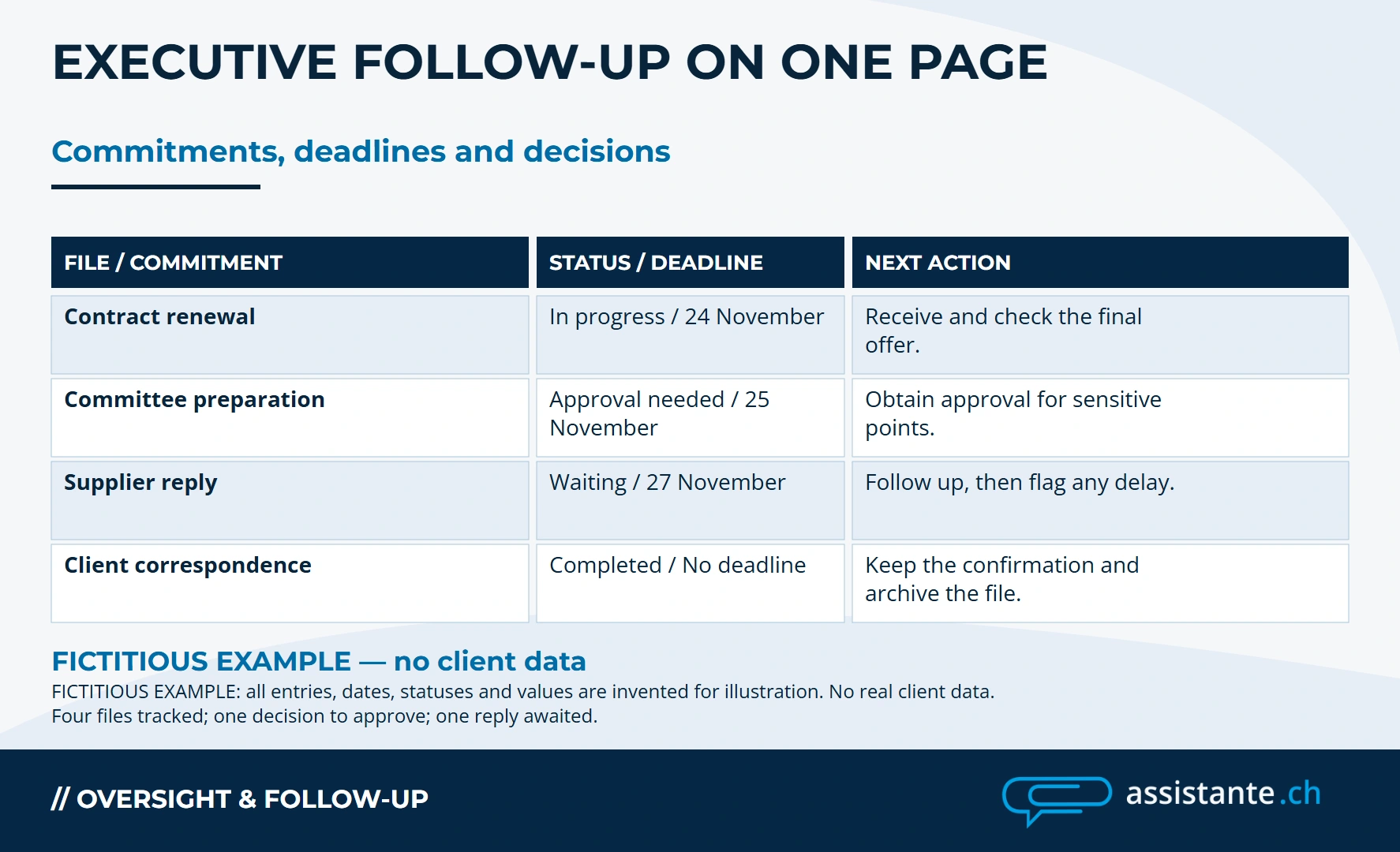
An executive summary brings together commitments, deadlines and decisions that need attention. View full-size infographic · View mobile version.
Do enough groundwork to make the recommendation trustworthy
Consider a hypothetical supplier delivery. Two dates are offered, the cost is unchanged, and the client is due to visit on Friday. Before recommending a date, the coordinator checks whether the supplier can still reserve it, whether the receiving team will be present, and whether the earlier arrival would genuinely allow time to prepare.
With those points confirmed, the director could receive this:
Illustrative executive update
Subject: Supplier delivery — confirmation needed by 13:30
The supplier can hold Tuesday’s delivery until 14:00. Thursday is also available at the same confirmed cost. The receiving team can accept Tuesday, which would leave time to check the materials before Friday’s client visit.
I recommend Tuesday. May I confirm that date by 13:30? Once approved, I will notify the supplier and receiving team and update the visit preparations.
The director can assess the recommendation without reopening the email chain. The options and practical consequences are stated, the deadline has a reason, and someone has accepted responsibility for the next steps.
A useful recommendation also has limits. If the supplier has mentioned Tuesday without confirming availability, the update must say so. If finance has not checked the revised terms, the cost remains unverified. Confidence in the wording should follow confidence in the information. Polished prose cannot make an uncertain commitment safe.
Deadlines deserve similar care. When an approval is unlikely to arrive before the supplier’s cutoff, the coordinator can seek an extension or alert the director through the agreed urgent channel. An unanswered message does not authorize a new commercial commitment.
Know which decisions need to reach the director
Repeated requests for minor approvals can exhaust the value of even the clearest updates. If a routine change falls within an existing mandate and agreed financial or operational limits, the appropriate action may be to deal with it and report what was done. Decisions affecting an important customer, a new financial obligation, a contractual term or a sensitive relationship may require explicit authorization.
These boundaries are easier to apply when they are settled before a difficult situation arises. The executive and the person coordinating the work should agree which commitments can be made independently, what information must be checked first, when an exception warrants a call, and who can act if the usual decision-maker is unavailable.
Some matters are better settled in conversation, particularly when the consequences are sensitive or the available choices require discussion. A short written confirmation afterwards can record the decision, its conditions and the agreed responsibilities.
Such an agreement also improves everyday reporting. “Tuesday delivery confirmed under the existing arrangement; receiving team informed; no action required” is a complete and useful update when the decision was already authorized. There is no benefit in inviting the director to approve it again.
Within an Assistante.ch service mandate, preparation, coordination and follow-through are responsibilities to define with the client. The underlying office management capabilities support the work; the mandate sets the boundaries for authority, confidentiality and escalation. Clear boundaries also prevent routine matters from travelling unnecessarily up the decision chain.
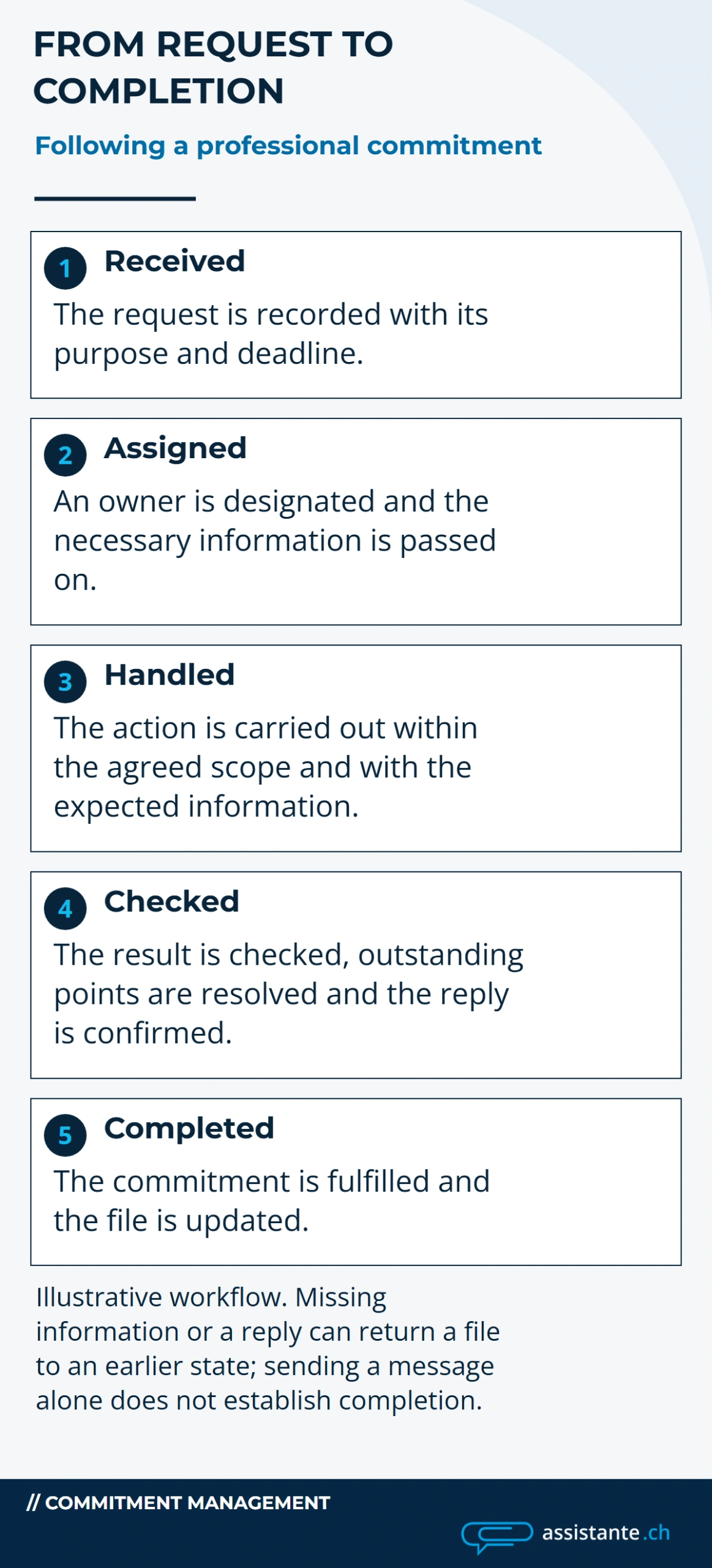
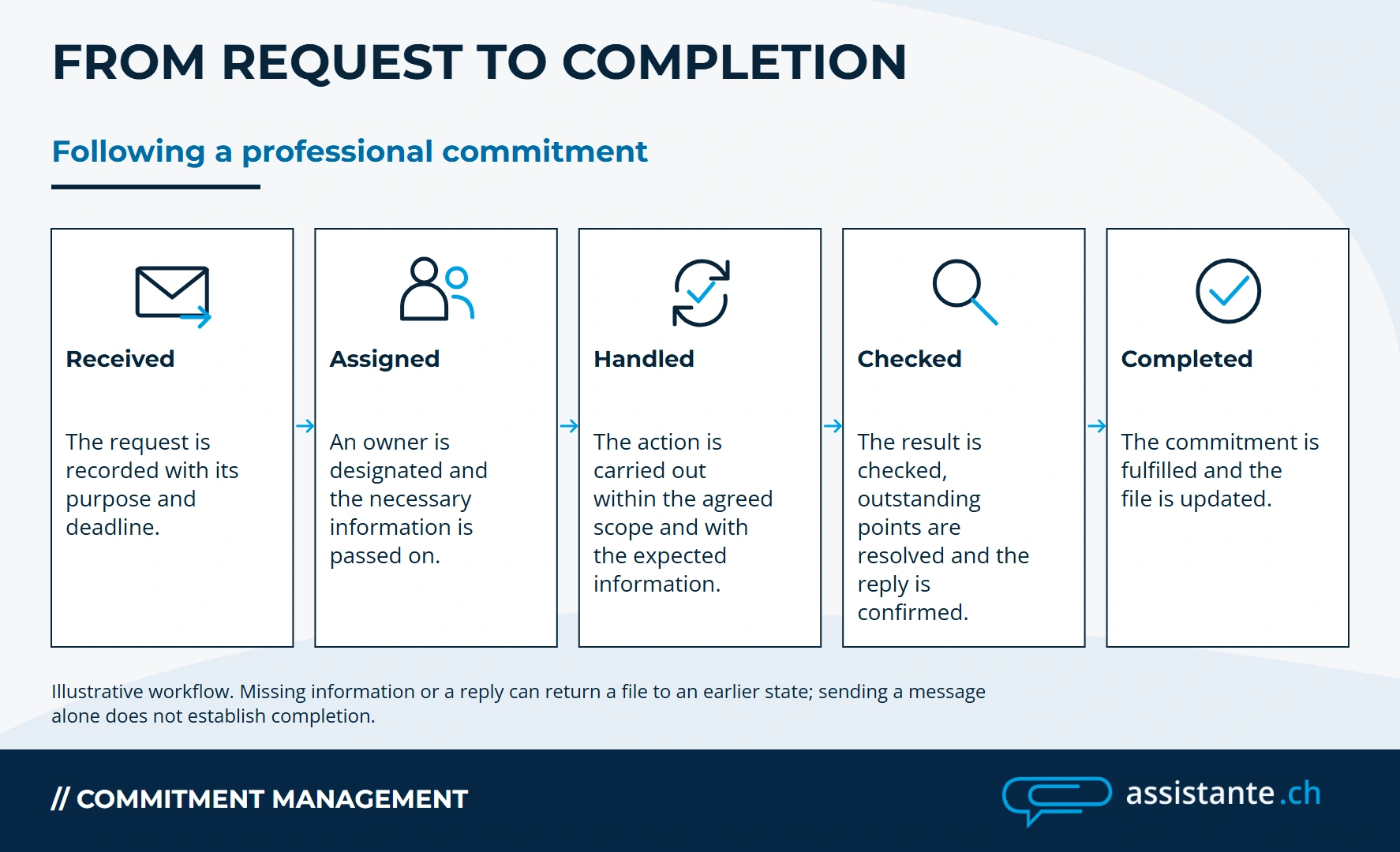
A commitment needs an owner, a checked result and follow-up of any outstanding points. View full-size infographic · View mobile version.
Carry the answer through to the people who depend on it
Once the director approves Tuesday, the job continues. The supplier needs confirmation, the receiving team needs the final arrangement, and anyone preparing for the client visit needs to know what changed. If the director’s approval carries a condition, that condition must reach the person implementing it.
Completion should be checked rather than inferred from the fact that an email was sent. A supplier acknowledgement, an amended appointment, a confirmed document or a recorded next action provides a more reliable end point. Where an answer is still missing, the working record should show who is following up and when the matter will be raised again.
This is also where discretion matters. People involved in delivery may need the confirmed date; they do not necessarily need the director’s private comments or the full correspondence behind the decision. Keep the useful operational record accessible to authorized colleagues and limit sensitive material to those who need it.
A handover during an absence should make the current situation intelligible without requiring a replacement colleague to replay every conversation. The latest verified position, the decision already taken, the outstanding response, the next deadline and the responsible contact will usually be more valuable than a folder of forwarded messages.
Much of this work belongs to the invisible workload carried around a leader (article in French): remembering promises, anticipating dependencies, noticing unanswered questions and ensuring that the right people learn what has been agreed. It is also consistent with the wider Execution Framework’s Sustain discipline, which addresses operating rhythm, continuity and handover after decisions have been made.
A well-prepared status update leaves the executive with a genuine choice, the evidence needed to make it and confidence that the answer will be implemented. The surrounding work stays with the people responsible for coordinating it.
To discuss how decision preparation, coordination and follow-through can be organized within a defined executive-support mandate, contact Assistante.ch.