Last Updated on 20 November 2026 at 11:57
A one-hour management meeting can leave several days of follow-up behind it. A supplier needs to confirm a deadline, a manager needs to send a document, and a client is waiting for the promised answer. Another decision still needs approval. The calendar does not necessarily say who will make sure these commitments are fulfilled. Yet someone will be thinking about them before the next meeting, sometimes several times a day.
In SMEs and family businesses in French-speaking Switzerland, that memory for outstanding work often rests with the leader. They know the files and the consequences of a delay: an invoice to challenge, a contract to renew, a reply promised to a colleague. They keep these matters in mind even when the next step depends on someone else.
This quiet work takes up a substantial part of professional life. It cannot be measured simply by counting emails or hours in meetings. It includes remembering commitments, connecting information, anticipating the next steps and checking that what was agreed has actually happened. When it rests on one person over a long period, the organisation depends on that person’s available attention as much as on their skills.
Table of contents
The work that does not appear in the calendar
Doing a task and taking responsibility for its follow-up are different jobs. Preparing a document is an identifiable activity. Asking for it, specifying the version required, reminding its author and checking that it has arrived are coordination work. If nobody owns that work, completing an individual step may not move the file forward.
The usual tools do not always make this burden visible. The calendar records appointments. Email retains exchanges. A management system lists files or transactions. Between them, there may still be verbal promises, replies that have not arrived, decisions postponed and information that has not found its way into a shared record.
A request can therefore look finished because an email was sent. The file remains open while a reply is outstanding, or while someone still needs to act on that reply. In organisations where nobody explicitly takes responsibility for this final part, the leader often becomes the collective memory for unfinished business.
When open files accumulate
The difficulty rarely takes the form of one impossible task. It comes from having many different matters open at once: a personnel question in the morning, a commercial request at midday, a contractual point in the afternoon, then a logistics problem that changes the day’s priorities. Each has its own contacts, documents, constraints and deadlines.
The leader changes context with every request. To answer properly, they need to retrieve the last decision, reconstruct what has happened since and identify the next step. When information is scattered across conversations or held by different colleagues, reconstructing it can take longer than giving the answer.
Teams feel the effects too. One colleague hesitates because the required approval is unclear. Another sends repeated messages to obtain a response. A third assumes someone else will follow up. Ordinary work increasingly passes through the leader, who becomes the point everyone needs to go through.
The number of matters still open, and the need to return to them repeatedly, weigh on concentration. A very busy day can generate many exchanges without resolving the questions that will demand attention again tomorrow.
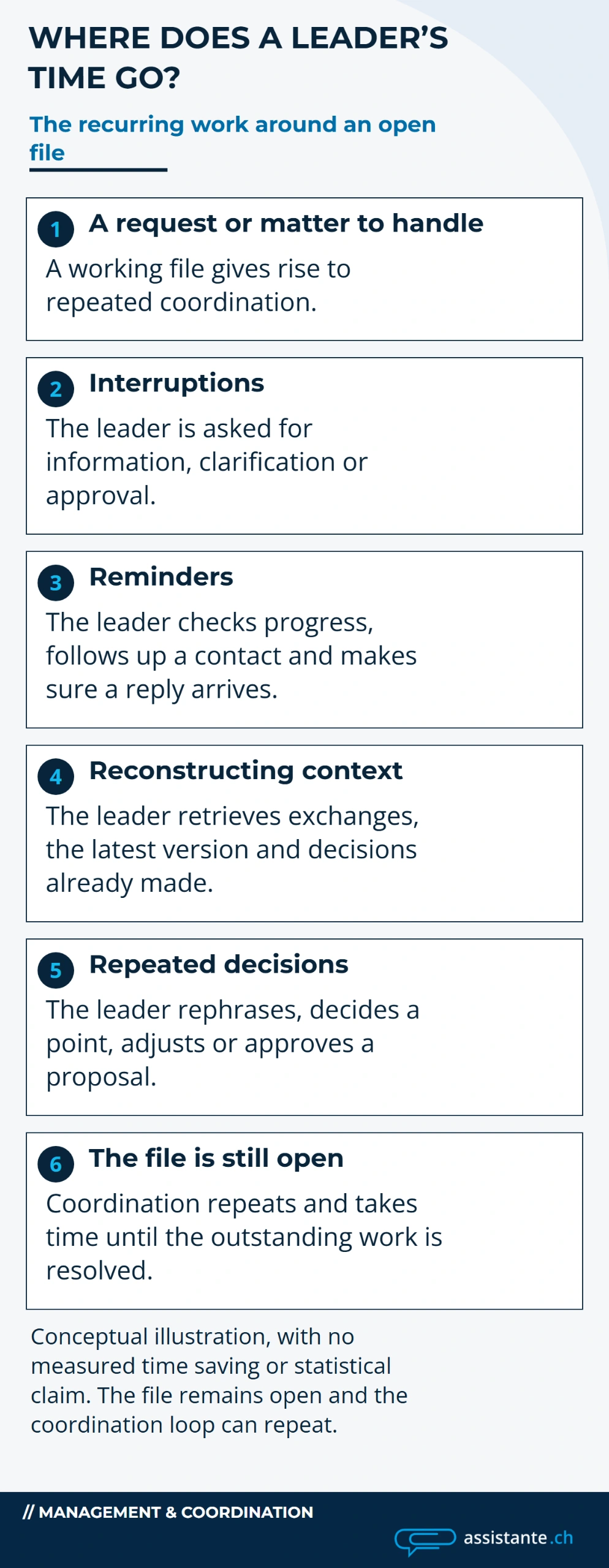
Repeated interruptions and follow-up continue to require attention while a file remains open. View full-size infographic · View mobile version.
What an apparently ordinary file reveals
Consider an illustrative example: an SME is preparing to renew a service contract. The manager concerned asks for a new proposal, finance needs to check some figures, and the provider is waiting for confirmation. The leader knows when the current contract ends. Everyone completes part of their work, but no shared record clearly explains what is still needed to conclude the matter.
The leader then checks whether the proposal has arrived, reminds finance of the date, asks whether the terms have changed and finds out what was sent to the provider. These checks serve a real purpose: an omission could lead to an unwanted renewal, an interruption or a rushed decision. Their repetition nevertheless exposes a weakness in coordination.
Organised follow-up would make the owner, next action, deadline and outstanding decision visible at any time. The leader would still receive information that commits the business, presented clearly enough to decide without reconstructing the entire history. A well-prepared status update supports that decision.
Organise follow-up to free attention
The first task is to make commitments visible without creating reporting that is heavier than the work it serves. An up-to-date list, a shared register or an existing business tool may be suitable. The choice depends on the nature of the work, the volume of information and confidentiality requirements.
For each matter requiring follow-up, it should be possible to establish what is expected, from whom, by when and what will trigger the next step. A missing reply is different from a decision that needs to be made; a completed file is different from a task that has merely been passed on. Exceptions and significant delays reach the appropriate person through an agreed route.
The review rhythm matters as much as the record. Some activities justify a daily check; others need a weekly discussion or a review before a particular deadline. Too many notifications and reports can recreate the burden they were meant to reduce. The practical aim is to provide usable information at the appropriate frequency.
Completion also needs to be defined: who confirms that a commitment has been fulfilled, where the useful evidence is kept, which information must be retained and who needs to receive the result. This prevents matters already resolved from continuing to occupy conversations and the leader’s memory.
The leader retains the decisions; follow-up has an owner
A leader cannot transfer every responsibility indiscriminately. A delicate negotiation, a financial commitment, a personnel matter or a strategic decision may require their personal judgement. Preparation and coordination can nevertheless be organised so that the matter reaches them at the right time, with the information they need.
This distinction is particularly useful when working with professional executive support. Its value lies in understanding the context, watching deadlines, handing work over clearly and identifying difficulties before they disrupt the business. Assistante.ch has also examined the contribution of executive assistants to leaders’ work, in French.
Within a defined mandate, an outsourced executive office in Switzerland can maintain part of this continuity: tracking priorities, coordinating contacts, preparing information, following up replies and keeping working records. The administration and office-management capabilities support that work. The mandate needs explicit responsibilities, suitable capacity, access limited to actual needs and confidentiality rules. It must also identify the decisions that remain with the client.
When several people are involved, continuity depends on an intelligible handover. Useful information should not disappear during an absence, temporary unavailability or a change of contact. Assistante.ch’s comparison of local, offshore and automated support, in French also examines the autonomy, supervision and continuity questions involved in choosing a service arrangement.
A working day that does not depend on remembering everything
A more dependable organisation is sometimes visible in small details. A document arrives without a second reminder. An important deadline is raised early enough. Meeting notes identify responsibilities and follow-up. After a business trip, the leader finds the files in a comprehensible state, with the decisions that genuinely require their attention.
To begin, revisit the commitments made at your last meeting. For each, record who owns the next action, the expected date and what will establish that the matter is complete. Examine together any commitments without an owner or deadline: these are the ones likely to return to your memory rather than to the team’s shared follow-up.
To discuss which follow-up responsibilities could be organised within a confidential mandate suited to your business, contact Assistante.ch for an initial discussion of your needs.