Last Updated on 20 November 2026 at 16:08
The work has been entrusted to a capable person. Instructions have been given, a deadline agreed and the necessary information passed on. A few hours later, however, the leader checks the messages, asks how things are progressing, corrects a detail and handles a reminder personally. By the end of the day, the file has moved forward. Their own workload has barely decreased.
In SMEs and family businesses in French-speaking Switzerland, responsibilities often develop around one person who knows the contacts, working habits and possible consequences of an error. The leader has good reasons to keep an overview. But if every delegated activity requires more checking, the time saved on execution is immediately spent on supervision.
The quality of delegation also shows in the work it removes from the person who delegated it. For this to happen, trust needs support from the way everyday work is organised.
Table of contents
Why is it so difficult to stop checking?
The need to check can have very practical origins. A leader may have seen a sensitive email sent too soon, an invoice left unanswered or a commitment made in a meeting disappear from the priorities. They particularly remember the consequences they had to handle. Another request for confirmation can feel safer than waiting.
A less visible difficulty keeps that need alive: the context required to do the work was never passed on. Exceptions are handled by habit; urgency depends on a commercial relationship or an earlier event that is missing from the file. People keep asking the leader because only they can explain these things.
Delegating an activity without this context leaves the other person to guess, interrupt the leader or take an unnecessary risk. Constant checking then appears to be a reasonable response to an incomplete handover. It becomes a problem when it settles into the normal way of working.
Differences in method matter too. An experienced colleague may achieve the required result by a different route. Accepting that autonomy means knowing what must remain consistent — quality, timing, confidentiality and the commitment made — and what can vary without an adverse consequence.
Delegation starts with an understandable working agreement
The longest instructions are not necessarily the most useful. A dependable arrangement rests on a few precise agreements: the expected result, reference information, deadline, decisions the person may take and situations in which they must ask for a decision.
Consider the preparation of a management meeting. Sending invitations, collecting documents, checking versions and following up contributions may fall within operational support. The leader retains decisions about sensitive subjects, commitments and information that cannot be circulated without permission. When this division is clear, they do not need to intervene in every email sent or document received.
The same reasoning applies to supplier reminders, contract follow-up, correspondence and coordination between contributors. A delegated activity needs an identified owner, an accessible record of progress and a clear approach to exceptions. Information should be retrievable without relying on a private conversation or the memory of the last person who handled the file.
Control is maintained through visibility of commitments and exceptions, rather than observation of every action.
Five mechanisms that support dependable delegation
- A clear mandate: the scope, working rhythm and objectives are understood.
- Defined responsibilities: each person knows what they handle and what they need to refer.
- Agreed autonomy: execution can progress without continual approval.
- Planned exception handling: unusual situations and sensitive decisions follow a known route.
- Proportionate oversight: follow-up checks what matters without recreating micromanagement.
These are complementary mechanisms, rather than five chronological stages.
Information at the right time changes the working relationship
Good delegation does not require silence between the initial briefing and final delivery. It provides for follow-up suited to the work. For a routine activity, a concise account of what is complete, waiting or blocked may be enough. A sensitive matter may still require a check before an external communication or a decision that commits the business.
The content of the update matters more than its frequency. A message saying that “everything is progressing” provides little reassurance if it does not explain what remains to be done. Brief, factual information — document received, approval awaited, deadline protected, decision required — enables the leader to respond only where their involvement adds real value. See also preparing a status update that helps an executive decide.
The way difficulties are handled is equally revealing. A delay raised early can be managed. Missing information can be sought. An ambiguous instruction can be clarified. When people conceal exceptions because they fear the reaction, the leader discovers problems too late and understandably increases supervision. A sound professional relationship allows difficulties to be raised before they become incidents.
Trust develops over time: a commitment fulfilled, information protected, a difficulty reported and a file found in the exact state expected.
Different work needs different levels of oversight
The nature of the work determines the room to act. Arranging appointments within agreed availability does not require the same safeguards as approving a payment, sharing personal data or answering correspondence that could create a legal commitment.
A responsible organisation distinguishes work that can be carried out independently, work that requires approval and decisions reserved for the leader or an authorised specialist. Financial thresholds, permitted recipients, confidentiality rules and escalation arrangements should be understood before an urgent situation arises.
This discipline also protects the person entrusted with the work. They know the limits of their mandate and can act confidently within them. The leader retains oversight proportionate to the possible consequences. Final responsibility for some decisions remains attached to the role, even when preparation and follow-up are delegated.
When an external provider is involved, confidentiality cannot rest on a promise alone. Access rights, approved tools, document retention, return of information and continuity of follow-up need to be agreed. These arrangements are part of service quality.
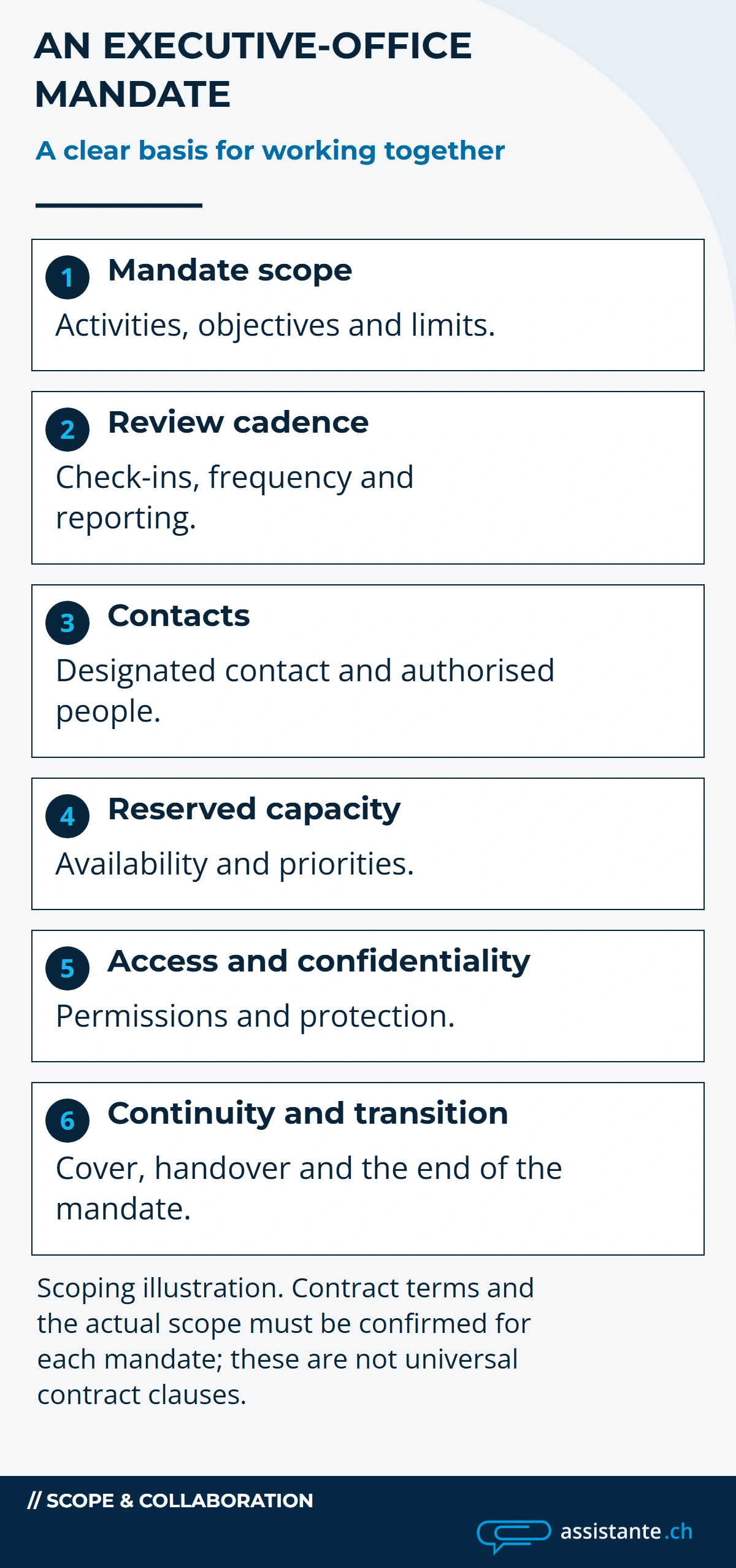
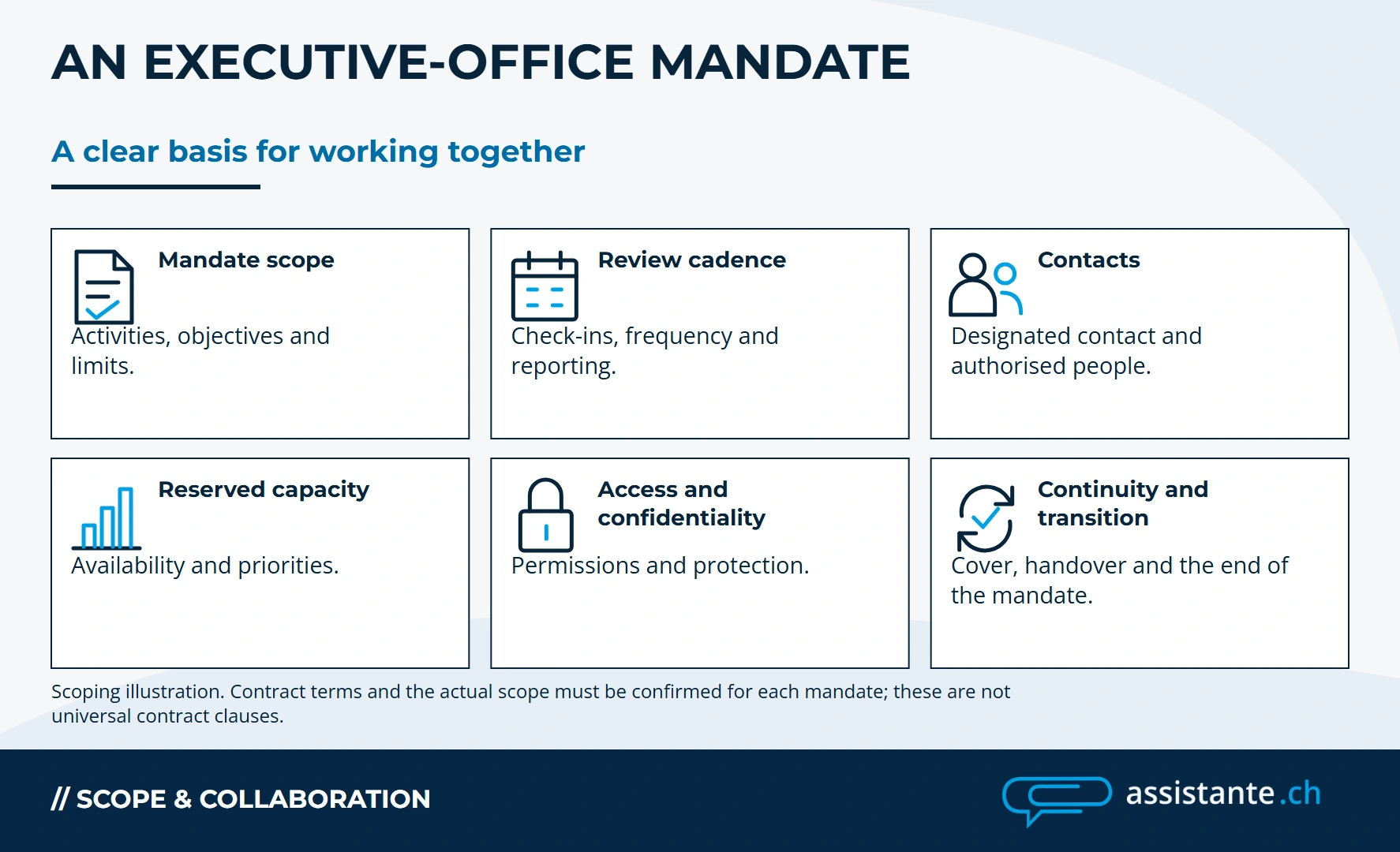
A mandate defines responsibilities, capacity, authorised access and continuity arrangements. View full-size infographic · View mobile version.
The real test comes when someone is absent
Delegation may seem to work perfectly while the same people remain present and available. Weaknesses emerge during an absence, business travel, a change of colleague or a period of heavy workload. Who knows which commitments remain open? Where is the correct document version? Who can take over a reminder already sent?
Continuity needs proportionate documentation, understandable responsibilities and information accessible to authorised colleagues. It also needs a sufficiently stable working relationship so that files do not start again from the beginning with every change of contact.
Within a defined mandate, an outsourced executive office can support this organisation by coordinating priorities, following up replies, keeping working records and maintaining operational continuity. The administration and office-management capabilities support those responsibilities. The expected quality depends on discretion and judgement as well as on keeping files clear and ready to hand over. To compare supervision requirements between service models, see Assistante.ch’s analysis of local, offshore and automated support in Switzerland, in French.
Examine delegation through three real files
The delegation and operational-continuity mini-diagnostic offers ten questions and an exercise using three current files. It helps identify a first verifiable improvement without assigning a score to your organisation.
Download the delegation mini-diagnostic — English PDF, 4 pages
The document is free, printable and can be completed on screen. No email address is required to download it; your answers are not automatically sent to Assistante.ch. The diagnostic is available in English.
Regain time that is genuinely your own
The clearest sign of effective delegation is often quiet. The leader no longer needs to ask whether the meeting has been prepared, contacts have replied or agreed actions have been followed through. They receive useful information at the agreed time and intervene when their judgement or authority is needed.
Start with one routine file that you still check several times a week. Agree with the person following it what the result should be, which decisions they may take, when the next update is due and what should prompt them to contact you. At the agreed review, examine what progressed without a reminder from you and what still needs clarification.
To discuss what could be entrusted to professional support, under which conditions and with what level of follow-up, contact Assistante.ch to describe the situation and consider an appropriate mandate.
Further reading: Swiss Confederation SME Portal — The art of knowing how to delegate.